
Sphyraena spp.
- Chevron barracuda to about 90 cm; great barracuda to 1.5 m or moreSize
- Year round, on outer reefs with currentBest time
- Least Concern (IUCN)Status
What to look for
Long, silver and torpedo-shaped with a jutting lower jaw and a mouthful of teeth. Chevron barracuda have dark chevron bars down the flanks and school in tight, slowly rotating formations that part around a diver and close again behind. Pickhandle barracuda have a dark lengthwise stripe. A single large fish holding in the water column, following at a distance, is the great barracuda.
Inside the school
Approach slowly from below and the school will often let you into the middle of it, one of the best photographs on the reef. They hold their shape as long as nobody lunges. Barracuda bites on divers are vanishingly rare and almost always involve a speared fish or a shiny object flashing in murky water.
Where to see it
- Reef dive · Outer reef Milln ReefMax depth 5-25 m.
- Reef dive · Outer reef Pellowe ReefMax depth 5-30 m.
- Reef dive · Agincourt Reef Barracuda BommieMax depth 22 m.
- Reef dive · Agincourt Reef Nursery BommieMax depth 24 m.
- Reef dive · Agincourt Reef The PointMax depth 25 m.
- Reef dive · Agincourt Reef Two RockMax depth 20 m.
Dive with us to see it
You might also see
- TrevallyBigeye trevally schooling in a slow silver tornado, and giant trevally hunting the reef edge.

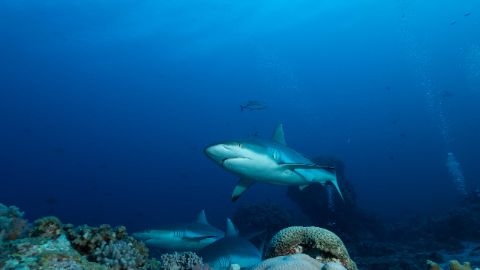
- Grey reef sharkThe classic reef shark: a stocky grey patroller of walls, drop-offs and current points, often in groups.
- Manta rayAn occasional visitor to the outer bommies: a reef manta gliding past can be the dive of the trip.

